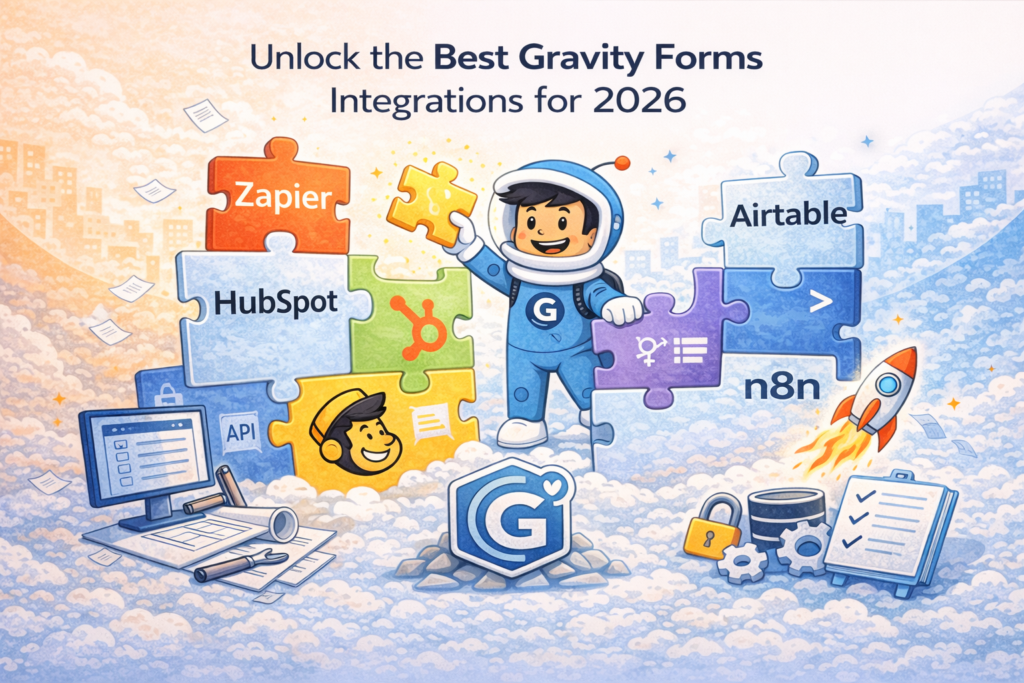
The best Gravity Forms integrations make a form much more useful than a simple entry collector inside WordPress. With the right setup, a form submission can send data to a CRM, add a subscriber to an email list, look up existing records, or trigger a larger automation workflow.
That is why the best Gravity Forms integrations are not all the same type of tool. Some are business platforms you may want to connect to, like HubSpot or Airtable. Others are the connection methods that make those workflows possible, such as Zapier, Webhooks, API Connector for Gravity Forms, or n8n Connector for Gravity Forms.
If you want to explore the wider ecosystem first, start with GravityWP add-ons for Gravity Forms.
Quick picks: which Gravity Forms integration fits which job?
| Best for | Recommended option | Why it fits |
| Standard CRM syncing | HubSpot or Salesforce | Best when you want a supported, feed-based CRM connection for common sales and marketing workflows. |
| Email list growth | Mailchimp or ActiveCampaign | Best when the goal is subscriber collection, tags, list management, and follow-up automation. |
| Internal records and lookups | Airtable or Dynamics 365 | Best when the form needs to work with existing records, not just create new submissions. |
| Fast no-code automation | Zapier | Best when you want quick app-to-app automation with broad app coverage. |
| One-way custom delivery | Webhooks Add-On | Best when you only need to send form data to a custom endpoint after submission. |
| Two-way API workflows | API Connector for Gravity Forms | Best when you need GET or POST requests, authentication, response mapping, or live field updates. |
| Advanced multi-step automation | n8n Connector for Gravity Forms | Best when one submission needs to trigger a larger workflow and return data to the entry. |
How Gravity Forms integrations usually work
In practice, most Gravity Forms integrations fall into three routes.
1. Official add-ons
This is the easiest place to start when Gravity Forms already supports the platform you want to use. Official add-ons are usually the cleanest option for standard CRM or email workflows.
2. Webhooks
The Webhooks Add-On is useful when there is no official add-on but you still need to send data to an external system after submission. This is the right route when the workflow is mostly one-way.
3. API-based workflows
This is the more flexible route when you need to query an API, use custom authentication, pass dynamic parameters, or map the response back into form fields. That is where API Connector for Gravity Forms becomes especially useful.
If one form submission needs to trigger a broader automation process, n8n Connector for Gravity Forms gives you a stronger route into multi-step workflows. If you are new to n8n itself, the best starting point is How to Set Up an n8n Instance.
A simple rule helps here: start with the official add-on when Gravity Forms already supports your target platform. Move to Webhooks when you only need outbound delivery. Choose API Connector for Gravity Forms when the form needs GET or POST requests, authentication handling, or response mapping back into fields. Choose n8n Connector for Gravity Forms when one submission needs to trigger a broader, multi-step automation workflow.
1) HubSpot
HubSpot is a strong fit when your form is part of lead capture, contact management, or marketing follow-up. It works well for demo requests, contact forms, sales inquiries, and support handoffs where the submitted data needs to land inside a CRM instead of staying in WordPress.
HubSpot becomes even more useful when the form needs to pull data back in, not just push it out. That is where the Gravity Forms HubSpot integration tutorial is especially helpful. It shows how to use API Connector for Gravity Forms to look up a contact by email and return first name, last name, and phone number into your form.
If your goal is better lead handling and cleaner contact data, HubSpot is one of the strongest Gravity Forms integrations to consider.
2) Salesforce
Salesforce is a practical pick when your Gravity Forms submissions need to fit into a structured sales process. It is a natural fit for sales inquiries, onboarding, account workflows, and service requests where the data needs to reach the correct CRM object quickly.
If you need more than a simple feed-based sync, the Gravity Forms Salesforce integration tutorial shows how to use API Connector for Gravity Forms with OAuth 2.0 and a SOQL query to auto-fill Gravity Forms fields by email.
That makes Salesforce a good option not only for standard CRM syncing, but also for more intelligent record lookup workflows.
3) ActiveCampaign
ActiveCampaign is a strong option for email follow-up and contact-list growth. It works well when your form is used for lead generation, newsletter signups, quote requests, or other marketing flows that need a subscriber or contact to move into your email platform immediately.
If your workflow needs a smoother repeat-user experience, the Gravity Forms ActiveCampaign integration tutorial shows how to use API Connector for Gravity Forms to fill fields like first name, last name, and phone after the user enters an email address.
That makes ActiveCampaign a strong choice when you want both post-submit automation and cleaner form input.
4) Mailchimp
Mailchimp remains one of the simplest Gravity Forms integrations for subscriber capture and email list growth. It is the practical choice when you do not need a more complex automation stack and the main goal is to move signup data directly into an audience.
That simplicity is exactly why Mailchimp still deserves a place in this list. Not every site needs a lookup workflow or advanced API logic. Some just need a dependable path from form submission to email follow-up.
5) Airtable
Airtable is useful when your form needs to work with structured records, internal data, or operational workflows. It is better understood as a flexible records platform than as “just another integration.”
That makes Airtable a strong fit for directories, internal request systems, project tracking, lightweight ops workflows, and record lookups. The Gravity Forms Airtable integration tutorial shows how to use API Connector for Gravity Forms to auto-fill Gravity Forms fields with Airtable data.
If your workflow is more database-oriented than CRM-oriented, Airtable is one of the most practical platforms to connect with Gravity Forms.
6) Microsoft Dynamics 365
Microsoft Dynamics 365 is worth considering when your customer or operational data already lives in Microsoft’s ecosystem. It is especially useful for businesses that rely on Dataverse and want WordPress forms to connect to the same source of truth.
The Gravity Forms Dynamics 365 integration tutorial shows how to connect Gravity Forms to Dataverse using API Connector for Gravity Forms and OAuth 2.0 client credentials.
If your team already works inside Microsoft tools, this is one of the strongest enterprise-style integration paths for Gravity Forms.
7) Zapier
Zapier is one of the easiest ways to automate a Gravity Forms submission into another app. It is a good fit when your team wants quick setup, broad app coverage, and a familiar trigger-and-action model.
That makes Zapier a strong option for non-technical users and smaller teams that care more about speed than deep customization. But once workflows become more advanced, many teams start looking for more control over costs, logic, hosting, and data flow.
If that sounds familiar, the best follow-up reads are n8n vs Zapier: Which Automation Tool Actually Fits Your Work? and How to Replace Zapier with n8n.
8) Webhooks Add-On
The Webhooks Add-On is a strong option when you need to send Gravity Forms data to a custom endpoint after submission. This is the right route when a service can receive an HTTP request but does not have its own official Gravity Forms add-on.
If the workflow is one-way, webhooks may be enough. But if the form needs to query an API before submission, use authentication methods beyond a basic webhook setup, or map the response back into fields, then API Connector for Gravity Forms is the better fit.
9) API Connector for Gravity Forms
API Connector for Gravity Forms is GravityWP’s flexible option for connecting Gravity Forms to external APIs and data services. It supports GET and POST requests, form-value parameters, custom headers, multiple authentication methods, and response mapping back into form fields.
That makes it especially useful when your form needs to do more than send data after submission. It is a strong fit for lookups, prefill workflows, response-based field updates, and systems that do not have a ready-made Gravity Forms add-on.
If your workflow needs more than a one-way push, this is usually the point where a standard add-on stops being enough. API Connector is the better fit when you need to look up a record before submission, pass dynamic parameters to an external API, or write the API response back into Gravity Forms fields in real time.
For deeper setup guidance, use the API Connector documentation. If you want real examples, start with the HubSpot tutorial, Salesforce tutorial, ActiveCampaign tutorial, Airtable tutorial, or Dynamics 365 tutorial.
10) n8n Connector for Gravity Forms
n8n Connector for Gravity Forms is GravityWP’s advanced option for teams that need multi-step automation around form submissions. It is built for workflows where the form submission is only the start of the process.
This is the stronger choice when a single submission needs routing, enrichment, conditional logic, or actions across several systems at once. GravityWP’s n8n Connector documentation explains the connection and feed setup, while the Build AI-Powered Workflows in Gravity Forms with the n8n Connector tutorial shows a real workflow where a Gravity Forms submission is sent to an AI agent and the response is written back into the form flow.
If you are exploring n8n for the first time, these companion guides also help:
- How to Set Up an n8n Instance
- Self-Host n8n with Docker on a VPS
- One-Click n8n Hosting
- Cloudflare Tunnel + n8n
- How to Replace Zapier with n8n
Which Gravity Forms integration is right for your workflow?
If your priority is a standard CRM or email sync, start with the official add-on when Gravity Forms already supports the tool.
And If your form only needs to send data outward to a custom service, the Webhooks Add-On is often enough.
But If your form needs to query an API, use custom authentication, or map a response back into fields, start with API Connector for Gravity Forms.
Now If one submission needs to trigger a broader multi-step workflow in an automation engine, start with n8n Connector for Gravity Forms.
And if your workflow is more about storing or syncing entries into a database table, not just calling an API, it is also worth exploring Entry to Database.
Final thoughts
The best Gravity Forms integration is not the one with the biggest name. It is the one that matches the actual job behind the form.
If you only need a supported CRM or email sync, start with the official Gravity Forms add-on. If your workflow needs outbound delivery to a custom service, start with Webhooks. But If your form needs API lookups, response mapping, or reusable authenticated connections, start with API Connector for Gravity Forms. And if a single submission needs to trigger a larger automation flow in n8n, start with n8n Connector for Gravity Forms.For the broadest next step, visit GravityWP add-ons for Gravity Forms. If you already know your workflow is API-based, go straight to API Connector for Gravity Forms. If your goal is advanced multi-step automation, start with n8n Connector for Gravity Forms.
Best Gravity Forms integrations – FAQ
Yes. Gravity Forms includes official add-ons for services such as HubSpot, Mailchimp, ActiveCampaign, Salesforce, Zapier, and Webhooks.
A feed is the configuration that tells a form how submission data should be sent to an add-on or external service.
Use Webhooks when you only need to send data out after submission. Use API Connector for Gravity Forms when you need GET or POST requests, authentication methods, custom headers, or response mapping back into form fields.
Zapier is a good fit when you want quick trigger-and-action automation with broad app coverage. n8n Connector for Gravity Forms is the better fit when you need a larger multi-step workflow, response mapping back into the entry, or tighter control over how the automation is hosted and structured.
Our Premium add-ons for Gravity Forms

All Entries
All your new Gravity Forms entries in one central place. Stop navigating between multiple forms to find new entries. Get immediate oversight and full control with a powerful, unified dashboard.

Update Multiple Entries
Trigger the update of multiple entries in a target form by submitting an entry in a trigger form.

List Text
Add features like textarea, placeholder and custom validation to a column or multiple columns in a Gravity Forms List Field.

List Number Format
With this Gravity Forms Add-on you can change List Field columns into a number field, do calculations within a row or column. Extra merge tags are available with total counts of columns.
Read tutorials about

How to Create a Public Submission Business Directory in WordPress (Gravity Forms + GravityView)
Build a moderated business directory where users submit listings through a form, admins approve entries, and approved businesses appear in a searchable GravityView directory.

How to Create an Event Workshop Registration + Waitlist System in WordPress
This guide shows how to set up a workshop registration + waitlist system in WordPress: register attendees until capacity is reached, waitlist the rest, approve entries, and auto-promote people when a seat opens using Gravity Forms, Gravity Flow, and GravityView.
Gravity Flow Form Submission Step Tutorial
The Gravity Flow Form Submission step pauses a workflow until another form is submitted, then continues once the handoff is complete. This guide shows how to connect two forms, prefill fields with mapping, send the correct secure link, and troubleshoot the most common “workflow didn’t move” issues.

Gravity Flow Delete an Entry Step Tutorial
The Gravity Flow Delete Entry step lets you trash or permanently remove Gravity Forms entries as part of a workflow. This guide covers the key settings, scheduling options (delay or date-based), and safe testing tips so you can follow retention and privacy rules with confidence.